
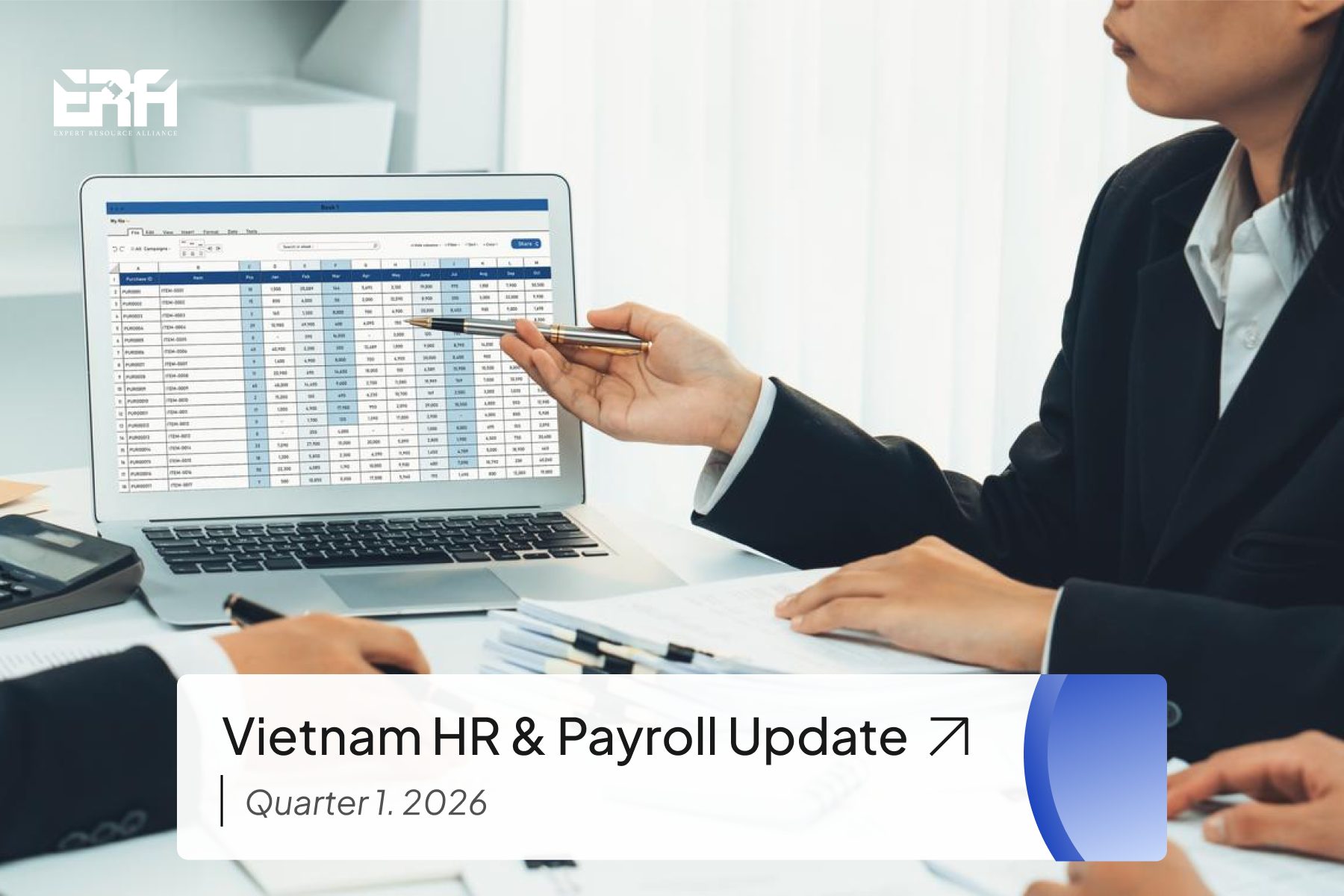
What’s Changed, What’s Shifting, and Where Employers Should Focus Next. Q1 2026 feels like a transition quarter for employers in Vietnam.
Some changes are already live. Others are clearly coming. At the same time, workforce behavior is shifting faster than many HR teams expected. Taken together, these forces are changing the role of HR and payroll from back-office execution to something much more exposed: cost control, compliance risk, and talent competitiveness now sit squarely on HR’s desk.
For employers, the question is no longer whether to adjust, but where to focus first.
What Changed in Q1 2026 (and What It Signals)
Flexible Unemployment Insurance Is Now Live
As of January 1, 2026, updates under the 2025 Employment Law officially took effect, introducing a more flexible approach to unemployment insurance. On the surface, this looks incremental. Contribution rates haven’t dramatically shifted. Day-to-day payroll calculations look familiar. But the intent behind the change matters more than the mechanics.
Unemployment insurance is no longer treated purely as a last-resort safety net. It’s being positioned as part of a labor system that accepts movement as normal. For employers, this has two immediate implications:
- Insurance reporting accuracy matters more than before
- Employees may feel more comfortable changing jobs, especially when the next role offers even modest upside
This doesn’t cause turnover on its own, but it lowers the psychological barrier to leaving.
Upcoming Compliance Changes Are Already Influencing Behavior
While centralized electronic labor contracts don’t become mandatory until July 2026, many companies are already reacting.
The direction is clear: labor data in Vietnam is becoming more standardized, more digitized, and easier to audit. Even before enforcement begins, companies are starting to feel pressure to clean up how contracts are created, stored, and tracked.
In practice, this means:
- Old contract templates are being reviewed (or quietly retired)
- HR teams are questioning whether their current systems can handle integration later this year
- “We’ll deal with it later” is becoming a risky strategy
Payroll: Same Rates, Higher Expectations
Payroll in Q1 2026 isn’t harder because of new taxes or higher contributions. It’s harder because tolerance for error is shrinking. What we’re seeing more clearly now:
- Payroll data and insurance reporting are being looked at together
- Digital submissions are becoming the norm, not the exception
- Inconsistencies across systems stand out faster
For companies still relying on manual checks, spreadsheets, or loosely connected tools, this is where risk quietly accumulates. Errors that used to take months to surface are now easier to spot and harder to explain away.
Workforce Reality Check: Mobility Is No Longer a Trend
A recent survey showed that roughly 77% of Vietnamese workers are open to new opportunities. That number shouldn’t be read as mass dissatisfaction. It’s something more subtle, and more challenging.
Most employees aren’t actively job hunting. But they are listening. They’re comparing. They’re responding to recruiters. They’re recalculating what’s “worth staying for.”
That changes the talent market in three important ways:
- Hiring becomes continuous – You’re competing for talent even when no one has resigned.
- Retention weakens quietly – High performers don’t signal disengagement before they leave.
- Stability becomes conditional – Tenure alone no longer protects you from turnover.
HR Teams Are Feeling the Squeeze
The combination of tighter compliance expectations and higher employee mobility is putting real pressure on HR operations. What’s becoming harder to sustain:
- Manual payroll adjustments
- Fragmented HR tools
- Reactive decision-making
What’s starting to separate stronger organizations:
- Integrated HR and payroll systems
- Cleaner, more consistent data
- The ability to answer basic questions quickly (turnover risk, compliance exposure, cost impact)
This isn’t about “digital transformation” as a buzzword. It’s about not being blindsided.
A Situation Many Companies Will Recognize
Take a growing logistics company operating across several provinces. Early 2026 brings:
- New unemployment insurance rules to interpret
- Headcount growth across locations
- Higher-than-expected resignations in operational roles
Their systems haven’t changed in years. Employee data lives in multiple places. Payroll and insurance reporting don’t always match on the first submission. Nothing is broken. But things start slipping:
- Corrections take longer
- Reporting confidence drops
- Management starts asking questions HR can’t answer quickly
Eventually, compliance pressure forces a decision. Systems are integrated. Data is standardized. Reporting improves.
The interesting part? Once the basics are fixed, leadership finally gets visibility into turnover patterns they couldn’t see before. Compliance forces the change. Strategy benefits from it.
The Real Risks to Watch
If there’s one mistake to avoid in 2026, it’s underestimating quiet risk.
- Compliance risk grows through small inaccuracies, not big violations
- Talent risk shows up suddenly, not gradually
- Operational risk builds when systems can’t talk to each other
Where Employers Should Focus Next
Not everything needs to be fixed at once. But priorities matter.
- First: Check the basics. Payroll accuracy. Insurance reporting. Data consistency.
- Second: Be honest about systems. If HR and payroll data don’t align easily, that’s a problem waiting to surface.
- Third: Revisit retention assumptions. If employees feel secure enough to leave, what are you giving them reasons to stay for?
Key Takeaways
Q1 2026 doesn’t bring dramatic headlines. What it brings is clarity.
Vietnam’s labor environment is becoming more data-driven, more transparent, and more fluid. Companies that continue treating HR and payroll as administrative functions will feel increasingly reactive. Those that treat them as infrastructure, something worth getting right, will have more control, better insight, and fewer surprises.

Ms. Tracy has worked in human resource consulting for over 15 years. A driven entrepreneur focused on business expansion and people development. She previously worked as Country Manager for an international Australia firm that specializes in global workforce management, as well as several key roles as Business Growth Director and Executive Search Director for both large local firms to effectively drive their business growth. A strong emphasis is placed on aligning organizational priorities/objectives with business needs. She has a large network of local business leaders and a thorough understanding of the local market.