
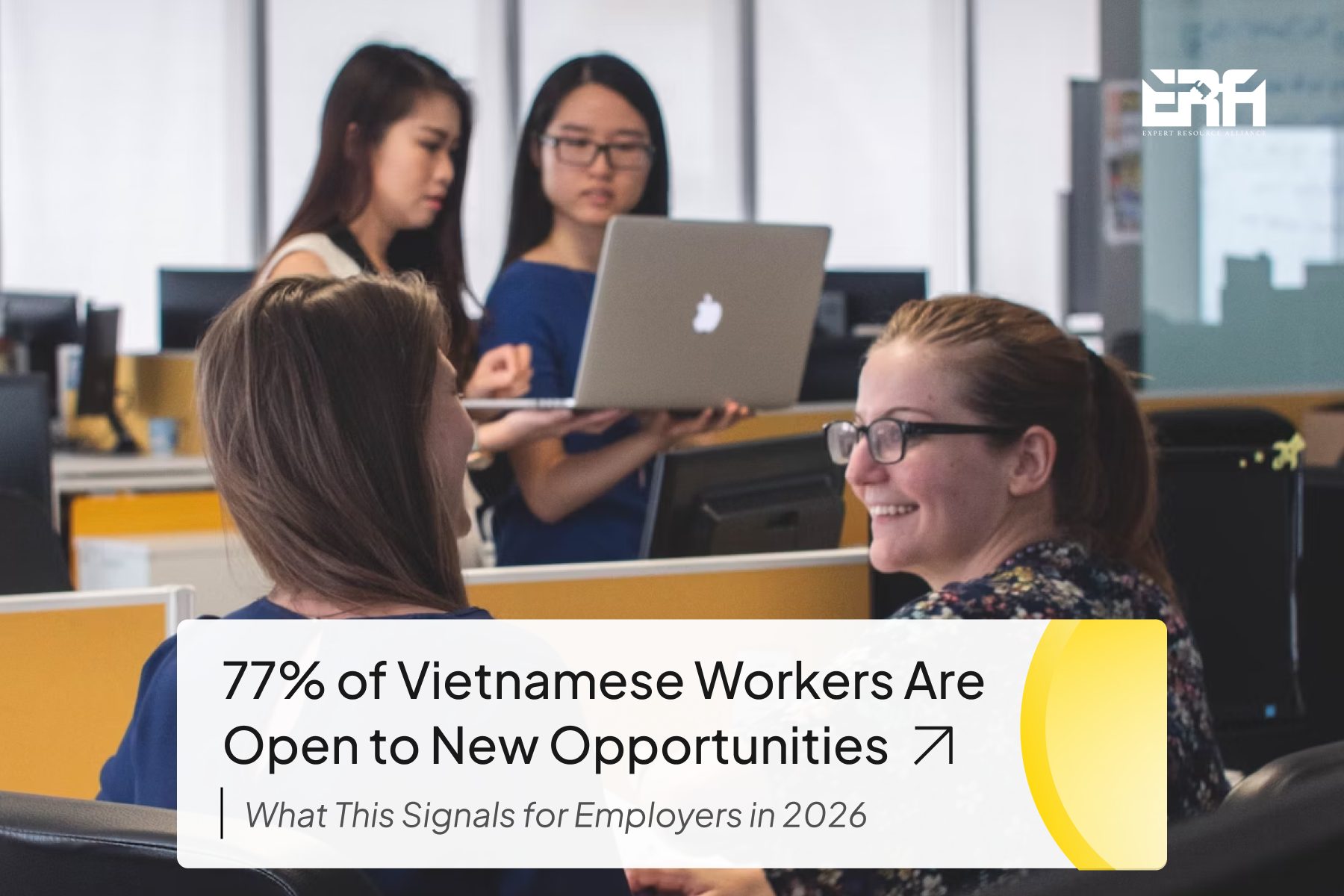
A recent survey reported by Vietnam News found that around 77% of Vietnamese workers are open to new job opportunities. On the surface, this may seem like a familiar headline in today’s competitive talent market. But the underlying signal is more significant: Vietnam is moving toward a high-mobility labor environment, where employee loyalty is increasingly conditional, and career decisions are more actively managed.
For businesses, this is not just a hiring challenge. It is a shift in how talent behaves, and how companies must respond.
Understanding the 77%: Openness vs. Active Job Seeking
It is important to interpret the 77% figure correctly. “Open to new opportunities” does not necessarily mean that employees are actively applying for jobs. Instead, it reflects a passive readiness to move if the right opportunity arises.
In practical terms, this means:
- A large portion of the workforce is continuously evaluating their current role against market alternatives
- Employees are more likely to engage with recruiters, even if they are not dissatisfied
- The threshold for switching jobs is lower than in previous years
This creates a fundamentally different labor dynamic. Companies are no longer competing only for active candidates, they are competing for nearly the entire workforce.
What’s Driving This Shift in Vietnam’s Workforce
The rising openness to new opportunities is not random. It is driven by a combination of economic, demographic, and cultural factors.
1. Salary Pressure and Cost of Living
Vietnam’s major economic hubs, particularly Ho Chi Minh City and Hanoi, have seen steady increases in living costs. Housing, education, and daily expenses are putting pressure on household budgets.
As a result:
- Employees are more sensitive to salary gaps
- Even small increases (10–20%) can trigger job changes
- Compensation benchmarking has become more transparent through online platforms
This creates a market where financial optimization is a key driver of mobility.
2. A Younger, More Ambitious Workforce
Vietnam has a relatively young workforce, with a large proportion of employees in early to mid-career stages. This demographic tends to:
- Prioritize learning, growth, and career acceleration
- View job changes as a normal part of progression
- Be more open to risk compared to older generations
When internal growth opportunities are limited, employees are more likely to look externally.
3. Changing Expectations Around Work
Workplace expectations are also evolving. Employees increasingly value:
- Flexibility and work-life balance
- Transparent leadership and communication
- Meaningful work and career development
If these expectations are not met, employees may not immediately resign, but they remain open to alternatives.
A More Competitive Talent Market, Even for “Stable” Roles
One of the most important implications of the 77% figure is that no role is truly “safe” anymore. Historically, certain positions, especially in operations, administration, or long-tenure roles, were considered relatively stable. Today:
- These roles are also exposed to market competition
- Employees are more aware of external opportunities
- Recruitment cycles are becoming shorter and more frequent
This leads to a more competitive and continuous talent market, where companies must actively maintain their attractiveness, not just during hiring periods.
The Hidden Risk: Passive Turnover
The biggest risk for businesses is not mass resignations, it is passive turnover. Employees may appear engaged and stable, but:
- They are open to external offers
- They may leave quickly when approached with a better opportunity
- High performers are often the most likely to move
This type of turnover is harder to predict and manage.
The Real Cost of Turnover
Turnover is often underestimated. Beyond recruitment costs, companies face:
- Lost productivity during transition periods
- Knowledge gaps and disruption within teams
- Increased pressure on remaining employees
In some industries, replacing a skilled employee can cost 1.5–2 times their annual salary when factoring in all indirect costs. This makes retention not just an HR issue, but a business performance issue.
A Practical Scenario: Mid-Level Talent in a Competitive Market
Consider a mid-level marketing manager working at a growing e-commerce company in Ho Chi Minh City. They are:
- Performing well
- Receiving regular salary adjustments
- Not actively job hunting
However, they are part of the 77%, open to opportunities. A recruiter reaches out with:
- A 20% salary increase
- A broader role scope
- Exposure to regional markets
Even without dissatisfaction, the employee begins to consider the move. Within a few weeks, they resign. From the company’s perspective, this feels sudden. But in reality, it reflects a broader pattern: employees are constantly evaluating their options, even when they appear stable.
What This Means for HR Strategy
The traditional HR approach, hire when needed, retain through compensation, no longer holds.
1. From Reactive Hiring to Continuous Talent Management
Companies need to shift from:
- Filling vacancies → building ongoing talent pipelines
- Short-term hiring → long-term workforce planning
This includes:
- Maintaining relationships with potential candidates
- Engaging current employees more consistently
2. Retention Needs to Be Data-Driven
Retention cannot rely on intuition alone. Leading organizations are:
- Tracking engagement and satisfaction metrics
- Identifying early signs of disengagement
- Using data to predict turnover risk
This allows HR teams to act before employees decide to leave.
3. Redefining the Employee Value Proposition (EVP)
Salary remains important, but it is no longer enough. A strong EVP includes:
- Clear career progression pathways
- Learning and development opportunities
- Flexible working arrangements
- A positive and transparent work culture
Companies that fail to evolve their EVP risk becoming less competitive, even if they offer competitive pay.
Industry-Level Impact: Not All Sectors Are Equal
While the trend applies broadly, some industries will feel it more strongly.
High-Mobility Sectors
- Technology
- E-commerce
- Professional services
These sectors already experience high turnover and will likely see increased competition for talent.
Labor-Intensive Industries
- Manufacturing
- Retail
Here, the challenge may be:
- Retaining skilled workers
- Managing large-scale workforce stability
SMEs vs. Larger Companies
Smaller companies may face greater challenges:
- Limited budgets for salary increases
- Lower employer brand visibility
- Fewer structured development programs
This makes strategic HR planning even more critical.
Where the Opportunity Lies
Despite the challenges, this shift also creates opportunities.
1. Building Stronger Internal Mobility
Providing employees with:
- Clear career paths
- Opportunities to move across roles or departments
can reduce the need for them to look externally.
2. Strengthening Employer Branding
In a market where most employees are open to change:
- Employer reputation matters more
- Online presence (LinkedIn, job platforms) becomes critical
- Employee advocacy can be a powerful differentiator
3. Investing in Managers
Research consistently shows that employees often leave managers, not companies. Improving:
- Leadership quality
- Communication
- Team culture
This can have a direct impact on retention.
What Businesses Should Do Now
This is not a future trend, it is already happening.
Audit Your Retention Risk
- Identify high-risk roles or teams
- Analyze turnover patterns and causes
Benchmark Your Offering
- Compare compensation and benefits against the market
- Ensure competitiveness, not just parity
Strengthen Engagement
- Conduct regular employee feedback surveys
- Act on insights, not just collect them
Develop Your Talent
- Invest in upskilling and career development
- Make growth visible and accessible
Key Takeaways: From Stability to Fluidity
The fact that 77% of Vietnamese workers are open to new opportunities is not a temporary spike – it reflects a structural shift. The labor market is becoming:
- More transparent
- More competitive
- More employee-driven
For businesses, the takeaway is clear. Retention is no longer about preventing exits, it is about continuously earning employee commitment.
Companies that adapt to this new reality will not only retain better talent, they will also build more agile, resilient organizations in the process.

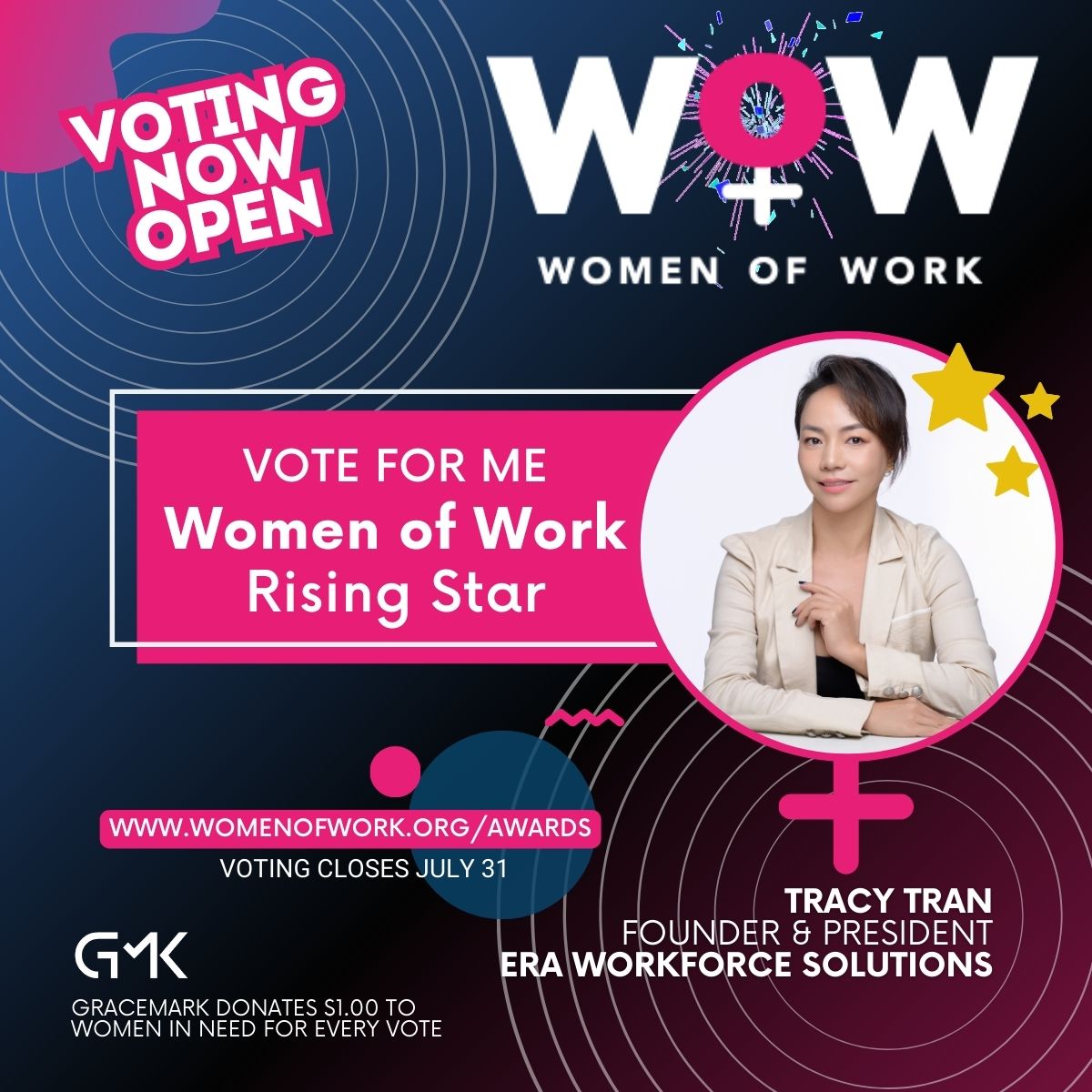
Ms. Tracy has worked in human resource consulting for over 15 years. A driven entrepreneur focused on business expansion and people development. She previously worked as Country Manager for an international Australia firm that specializes in global workforce management, as well as several key roles as Business Growth Director and Executive Search Director for both large local firms to effectively drive their business growth. A strong emphasis is placed on aligning organizational priorities/objectives with business needs. She has a large network of local business leaders and a thorough understanding of the local market.