
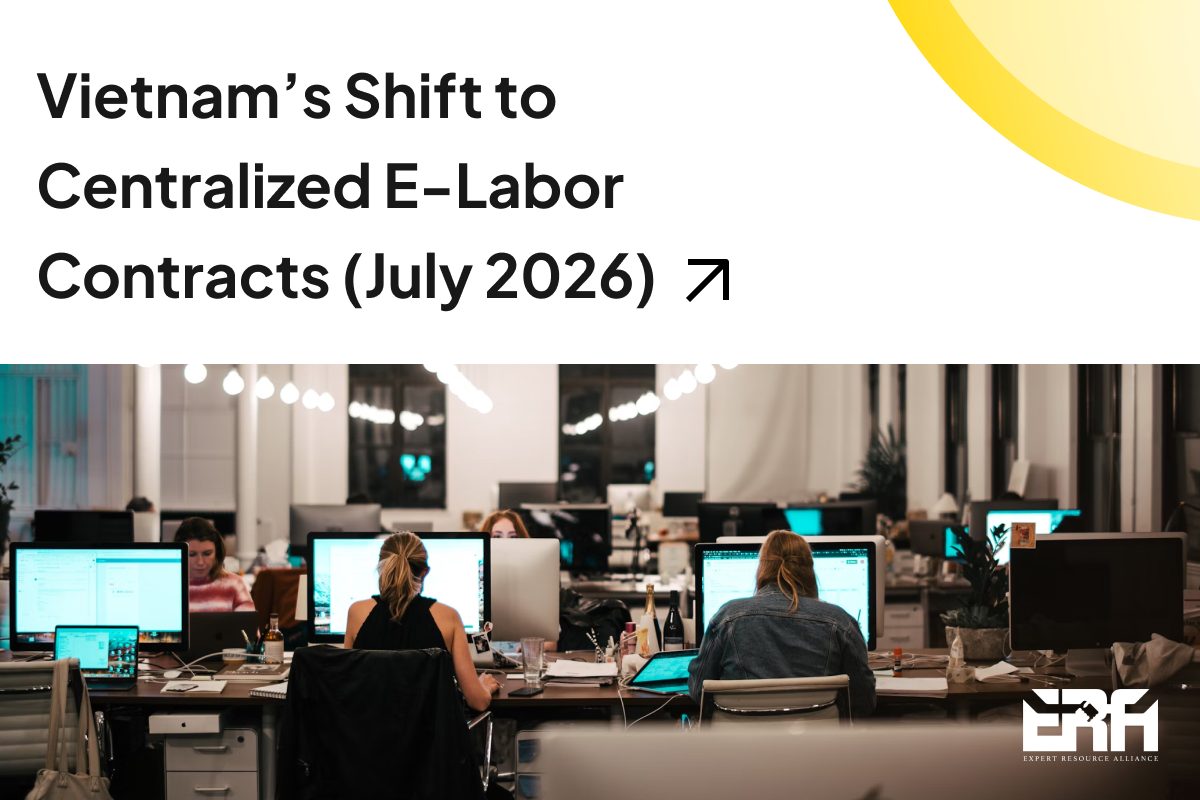
Vietnam is entering a new phase of labor regulation, one that moves beyond digitization toward centralized workforce governance. Under Decree 337, effective July 2026, businesses will be required to adopt centralized electronic labor contracts, fundamentally changing how employment relationships are documented, stored, and monitored.
This is not simply a compliance update. It represents a structural shift in how labor data is managed at a national level, bringing both operational implications and strategic opportunities for companies operating in Vietnam.
A New Regulatory Framework for Labor Contracts
Decree 337 introduces a requirement for enterprises to transition from fragmented, often paper-based contract management systems to standardized electronic contracts integrated with a centralized platform. At its core, the regulation establishes three key principles:
First, electronic labor contracts will carry full legal validity, provided they meet specific authentication and storage requirements. This reinforces Vietnam’s broader push toward recognizing digital transactions across sectors.
Second, contract data will need to be submitted, stored, or synchronized with a centralized system, likely managed or regulated by government authorities. This moves contract management from an internal HR function to a partially externally visible compliance process.
Third, the decree introduces stricter expectations around data integrity, traceability, and auditability, signaling a shift toward more proactive labor oversight. For businesses, this means that labor contracts are no longer just internal documents, they are becoming regulated data assets.
Key Requirements Under Decree 337
Mandatory Adoption of Electronic Contracts
Companies will be required to issue labor contracts in electronic form for applicable employee categories. While Vietnam has already allowed e-contracts under previous regulations, adoption has been inconsistent. Decree 337 effectively removes optionality. Organizations must ensure that:
- Contracts are digitally created, signed, and stored in compliant formats
- Electronic signatures meet legal authentication standards
- Contract lifecycle management (creation, amendment, termination) is fully digitized
This is particularly impactful for industries still reliant on manual HR processes, such as manufacturing, retail, and logistics.
Centralized Data Integration and Reporting
One of the most significant changes is the requirement for centralized contract data management. Rather than storing contracts solely within internal systems, businesses may need to:
- Upload or integrate contract data into a government-linked platform
- Ensure data is structured according to standardized formats
- Maintain real-time or periodic synchronization
This introduces a new layer of regulatory visibility. Authorities may gain faster access to employment data, enabling more efficient monitoring of compliance with labor laws, insurance contributions, and workforce reporting. For companies, this means that inconsistencies, such as mismatched contract terms, missing records, or outdated agreements, become far more visible.
Security, Authentication, and Compliance Standards
With centralized digital systems comes a heightened emphasis on data security and verification. Businesses will need to ensure:
- Use of compliant digital signature solutions
- Robust identity verification processes for both employers and employees
- Secure storage and transmission of sensitive employment data
This aligns with broader trends in Vietnam’s regulatory environment, where data protection and cybersecurity are becoming increasingly important. Failure to meet these standards could expose companies not only to labor compliance risks but also to data-related liabilities.
Why Vietnam Is Moving Toward Centralization
The introduction of Decree 337 is closely tied to Vietnam’s national agenda around digital transformation and administrative modernization. From a policy perspective, centralized electronic contracts offer several advantages:
- Improved transparency: Authorities can better track employment relationships, reducing informal labor practices
- Reduced disputes: Digitized, time-stamped contracts provide clearer evidence in labor conflicts
- Operational efficiency: Streamlined data flows reduce administrative burden for both businesses and regulators
According to insights from Vietnam Briefing, the move is part of a broader effort to digitize labor administration and integrate employment data into national systems, supporting more effective governance and policy enforcement. In essence, Vietnam is aligning its labor infrastructure with global trends, where workforce data is increasingly treated as structured, real-time information rather than static documentation.
Business Impact: From HR Process to Compliance Infrastructure
Operational Transformation
For HR teams, the shift to centralized e-contracts will require a fundamental redesign of workflows. Manual processes, such as printing, signing, scanning, and storing contracts, will need to be replaced with end-to-end digital systems. This includes:
- Contract generation platforms
- Digital signature tools
- Integration with HRIS or payroll systems
Organizations without existing digital infrastructure will face the steepest transition.
Increased Compliance Exposure
Centralization significantly raises the stakes for compliance. When contract data becomes accessible or reportable to authorities:
- Errors are easier to detect
- Non-compliance is harder to conceal
- Enforcement can become more consistent and data-driven
This shifts compliance from a reactive function to a continuous, system-based requirement. Companies will need to ensure that their contract data is not only complete, but also accurate, standardized, and up-to-date at all times.
Impact on Workforce Experience
From an employee perspective, electronic contracts can improve accessibility and efficiency. Employees may benefit from:
- Faster onboarding processes
- Immediate access to signed agreements
- Greater transparency in contract terms
However, companies must also consider:
- Digital literacy gaps among certain workforce segments
- Change management challenges during the transition
Balancing efficiency with usability will be critical.
Key Challenges Companies Should Anticipate
Despite its long-term benefits, the transition will not be frictionless. One of the primary challenges is legacy system compatibility. Many organizations operate fragmented HR systems that may not easily integrate with centralized platforms.
Data migration is another major concern. Converting existing paper or unstructured contracts into standardized digital formats requires:
- Significant manual effort
- High attention to detail
- Strong quality control processes
Additionally, many HR teams may lack the technical expertise needed to manage digital systems, creating a capability gap that must be addressed through training or external support.
A Practical Scenario: Mid-Sized Manufacturer in Vietnam
Consider a mid-sized manufacturing company employing 800 workers across multiple locations. Today, its HR processes rely heavily on:
- Paper contracts stored locally
- Excel-based tracking systems
- Manual updates for contract renewals
Under Decree 337, this model becomes unsustainable. To comply, the company would need to:
- Digitize all existing contracts into compliant electronic formats
- Implement a digital signature solution
- Integrate contract data with a centralized reporting system
- Train HR staff to manage digital workflows
- While the upfront investment may be significant, the long-term outcome includes:
- Reduced administrative workload
- Improved data accuracy
- Stronger compliance posture
This illustrates a broader reality: compliance-driven change often becomes a catalyst for operational improvement.
Strategic Opportunities Beyond Compliance
Forward-looking organizations will recognize that Decree 337 is not just a regulatory burden, it is an opportunity to modernize. Centralized, structured contract data enables:
- Better workforce analytics: Insights into contract types, durations, and workforce composition
- Improved planning: Data-driven decisions on hiring, retention, and cost management
- Stronger governance: Clearer oversight of employment practices across the organization
Moreover, companies that adopt efficient, transparent HR processes can enhance their employer brand, particularly in competitive talent markets. In this sense, compliance becomes a foundation for strategic HR transformation.
How Businesses Should Prepare Before July 2026
With the deadline approaching, preparation should begin well in advance.
1. Conduct a Contract and System Audit
Review all existing labor contracts and identify gaps in:
- Format and structure
- Storage and accessibility
- Compliance with digital requirements
Assess whether current HR systems can support electronic contract management.
2. Invest in Digital Infrastructure
Implement or upgrade systems that enable:
- Contract digitization and storage
- Digital signatures and authentication
- Integration with external platforms
Choosing scalable, compliant solutions will be critical.
3. Establish Data Governance Standards
Define clear protocols for:
- Data accuracy and validation
- Access control and security
- Ongoing updates and maintenance
This ensures that contract data remains reliable and audit-ready.
4. Upskill HR Teams
Provide training on:
- Digital tools and platforms
- Legal requirements for e-contracts
- Data management best practices
HR teams will play a central role in ensuring successful implementation.
5. Engage External Expertise if Needed
For complex transitions, businesses may benefit from:
- Legal advisors
- HR technology consultants
- Outsourcing partners
This can accelerate implementation and reduce risk.
Conclusion: A Compliance Mandate That Signals a Broader Shift
Decree 337 marks a turning point in Vietnam’s labor landscape. By mandating centralized electronic labor contracts, the government is not only improving regulatory oversight, it is redefining how employment relationships are managed in a digital economy.
For businesses, the implications are clear:
- Compliance will become more data-driven and transparent
- HR operations must evolve toward digital, integrated systems
- Early adopters will gain both operational and strategic advantages
Organizations that treat this as a transformational opportunity, rather than a compliance burden, will be better positioned to navigate Vietnam’s increasingly sophisticated regulatory environment. The shift is already underway. The question is not whether to adapt, but how quickly and effectively it can be done.

Ms. Tracy has worked in human resource consulting for over 15 years. A driven entrepreneur focused on business expansion and people development. She previously worked as Country Manager for an international Australia firm that specializes in global workforce management, as well as several key roles as Business Growth Director and Executive Search Director for both large local firms to effectively drive their business growth. A strong emphasis is placed on aligning organizational priorities/objectives with business needs. She has a large network of local business leaders and a thorough understanding of the local market.