

In April 2026, Vietnam was recognized by the World Bank as one of the top-performing countries in the Expanded Human Capital Index (HCI+) 2026, particularly among economies at a similar income level. For foreign businesses looking at Vietnam as a manufacturing base, expansion target, or talent hub, this isn’t just a feel-good headline.
It’s one of the more reliable signals available about workforce quality and how effectively a country turns education and health investment into productive employment.

Here’s what the data actually says, and what it should mean for hiring strategy in Vietnam.
What the HCI+ Measures
The HCI+ is the World Bank’s measure of how much human capital a person can expect to accumulate from birth through their working life, given the country’s health, education, and employment conditions. According to the World Bank’s methodology, it’s scored on a 0-325 scale, with each one-point gain corresponding to roughly 1% higher expected labor income.
Scores are built from three pillars:
- Health – adult survival rates and the share of children not stunted
- Schooling – learning-adjusted years of education and tertiary enrollment
- Work – labor force participation, wage employment, and unemployment
Unlike earlier human capital measures that stopped at age 18, the HCI+ extends into adulthood to assess whether the skills people build actually translate into productive jobs. That distinction matters for investors.
Vietnam’s Score: 2nd in ASEAN, Top at Its Income Level
According to Vietnam Briefing’s analysis of the 2026 release, Vietnam scored 216 out of 325 on the HCI+, placing it second in ASEAN behind Singapore (282) and ahead of three higher-income peers: Brunei (208), Thailand (202), and Malaysia (201).
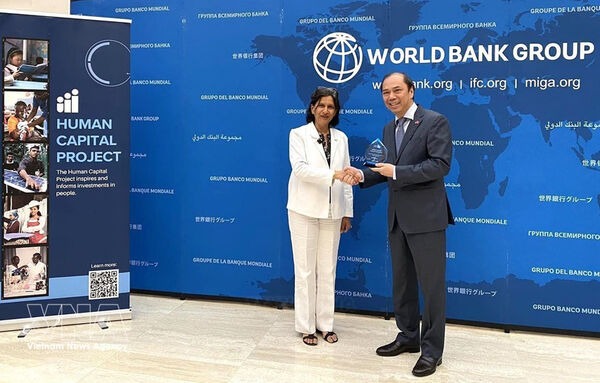
Vietnam was named one of the top 5 countries globally for human capital development at the 2026 Spring Meetings of the World Bank and IMF, held on April 16 at the World Bank headquarters in Washington, D.C. The distinction specifically recognizes leading performance among nations with similar income levels.
Where Vietnam Outperforms
- Schooling and Work Are the Strongest Pillars
Vietnam’s schooling score is its standout. Its harmonized learning-adjusted score of 485 is second in ASEAN behind Singapore (594), and ahead of every other regional peer. That puts Vietnam’s basic education system in a category of its own for a country at its income level.
The Work pillar is the second-strongest. Labor force participation among the working-age population is 87.9%, second only to Cambodia in ASEAN and above Singapore’s 85.4%.
As Vietnam News reported, the World Bank specifically noted significant improvements in wage employment in Vietnam, reflecting alignment between workforce training and the actual demands of a higher-productivity labor market.
- The Tertiary Education Gap
The clear gap is at the tertiary level. Tertiary enrollment stands at 19.8%, well behind Singapore, Malaysia, the Philippines, and Thailand. And while wage employment is improving, Vietnam’s wage employment share of 52.2% is still some distance from Singapore’s 90.6%, reflecting the continued share of self-employment and own-account work in the economy.
For foreign businesses, this is the practical caveat. Vietnam offers a deep, trainable, hardworking talent pool.
But highly skilled, university-qualified talent in technical and managerial roles remains in short supply, and this is where wage competition is intensifying fastest.
- A Tightening Labor Market
Vietnam’s labor market in 2025 reflects a workforce that is growing, increasingly trained, and earning more. According to the General Statistics Office of Vietnam data referenced in the Vietnam Briefing report:
- Labor force aged 15 and over: 53.3 million (Q3 2025)
- Employed persons: 52.3 million
- Working-age unemployment: 2.22%
- Trained workers with diplomas or certificates: 29.5%
- Average monthly income: VND 8.4 million (US$336), up 10% year-on-year
At the same time, disbursed FDI reached US$27.6 billion in 2025, the highest in five years, with manufacturing and processing accounting for 82.8% of that total. The simple read: more foreign capital is competing for a labor pool in which the skilled segment is below 1 in 3.
Policy Direction Through 2030
Two Politburo resolutions, signed in 2025, set the workforce policy direction:
- Resolution 71-NQ/TW (August 22, 2025) commits at least 20% of state budget expenditure to education and targets a workforce where 24% hold a college or university qualification by 2030
- Resolution 72-NQ/TW (September 9, 2025) reorients healthcare toward prevention and grassroots delivery, with at least 1,000 doctors rotated annually into commune-level stations through 2030
The World Bank’s recognition of Vietnam at the 2026 Spring Meetings was framed as an acknowledgment of both achievements and execution: turning state budget investments in education and health into measurable economic outcomes.
Start Hiring in Vietnam
Vietnam’s HCI+ 2026 ranking reinforces what many investors are already acting on: it is a strong market in which to build a team.
For foreign businesses entering Vietnam for the first time, ERA provides the local infrastructure to hire compliantly and get operations running without the complexity of setting up a legal entity.
Talk to ERA about building your team in Vietnam.

Ms. Tracy has worked in human resource consulting for over 15 years. A driven entrepreneur focused on business expansion and people development. She previously worked as Country Manager for an international Australia firm that specializes in global workforce management, as well as several key roles as Business Growth Director and Executive Search Director for both large local firms to effectively drive their business growth. A strong emphasis is placed on aligning organizational priorities/objectives with business needs. She has a large network of local business leaders and a thorough understanding of the local market.